
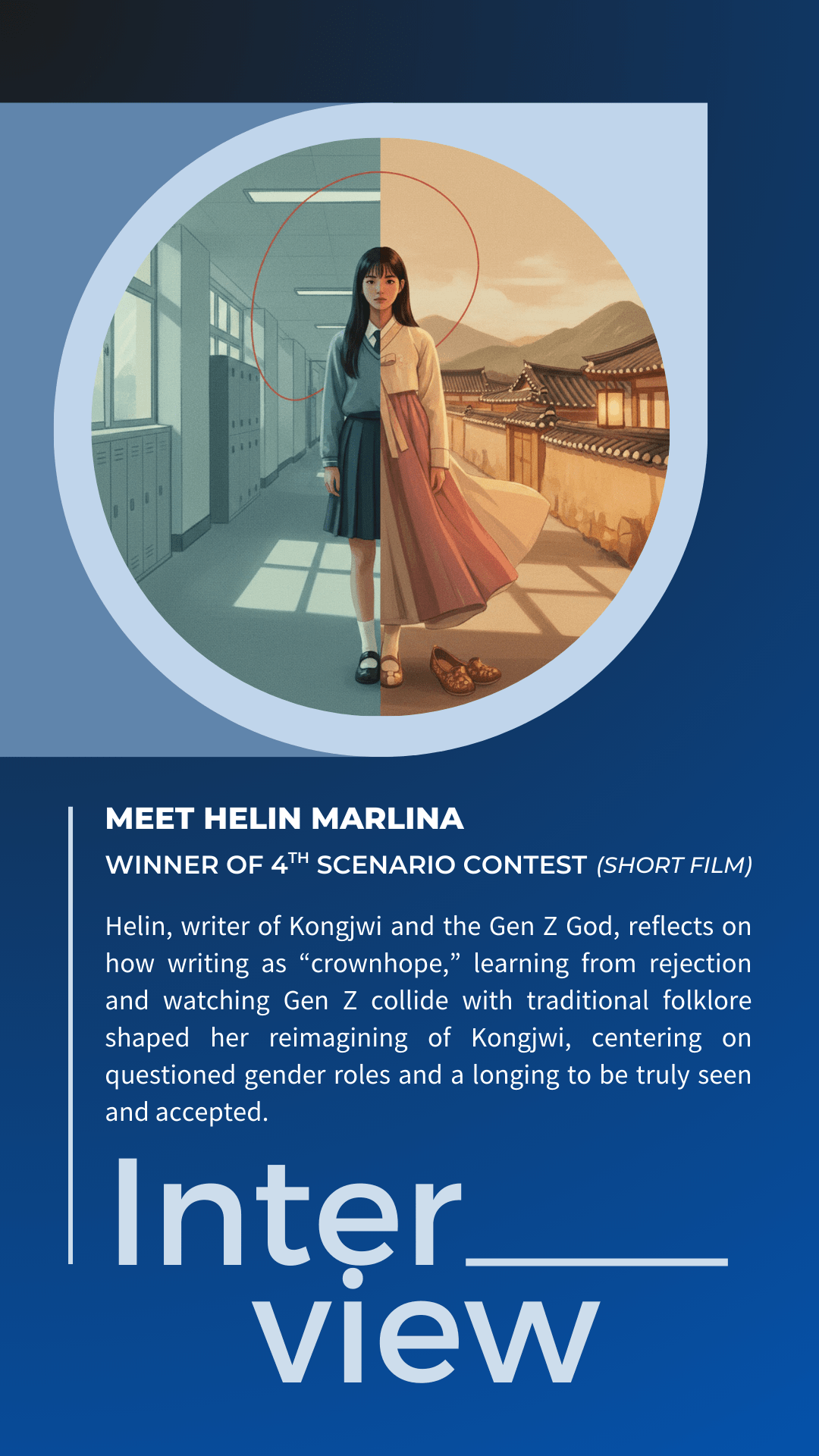
In the space where Korean folktales meet Gen Z reality, writer Helin Marlina finds her voice with Kongjwi and the Gen Z God. What started as a wish to see Kongjwi and Patjwi through the eyes of today’s girls grew, over multiple contest entries, into a bold reimagining that questions gender roles, family expectations, and who gets to be “good” in a story. Writing as “crownhope,” she folds her own experience with rejection and perseverance into the script, blending sharp humor with quiet emotional blows and giving her Kongjwi a need not just to be kind, but to be seen. In our conversation, Helin talks about the long road to this winning piece, how Gen Z language and online culture slipped into a Joseon village, and why rewriting old tales can open new space for readers who never saw themselves at the center.
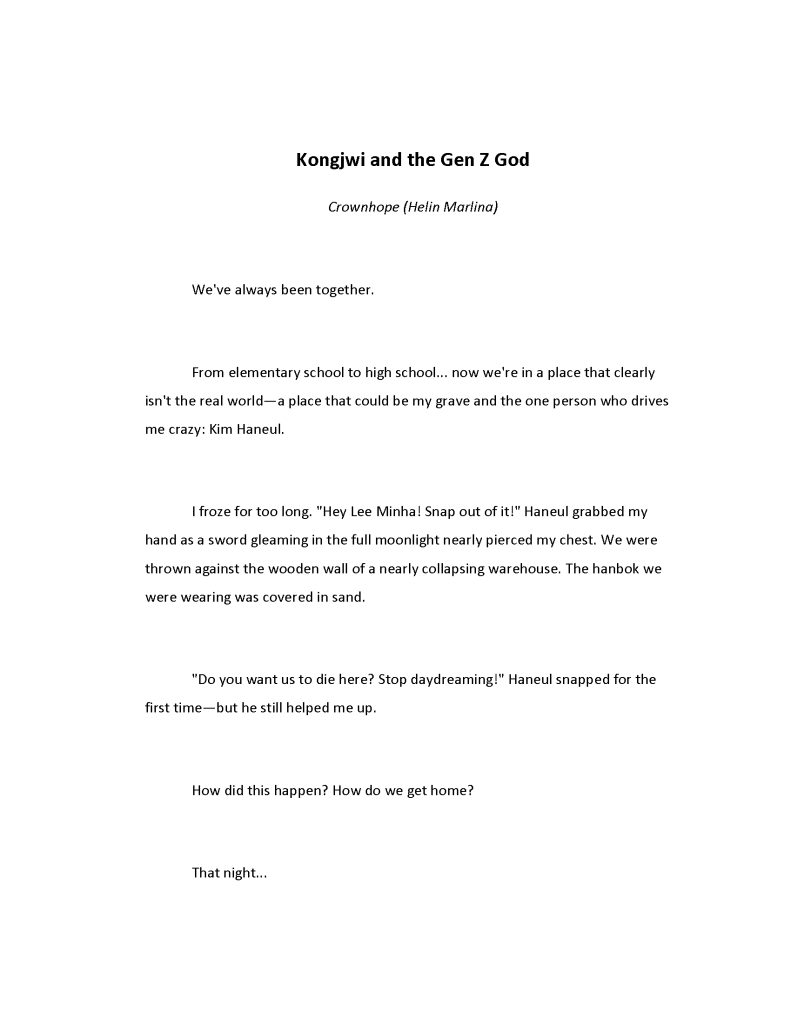
You’ve participated in all four editions of the contest; first without reaching the finalist stage, then finalist, then honorable mention, and now winner. What do you think changed most in your writing across these four editions?
Reflecting on this question brings me back to all the works I’ve written since the first edition. I realize my writing style has indeed changed a lot, though I didn’t pay much attention to it at first. Over the years, writing online under my pen name ‘crownhope’, I received more rejections than praises. Back then, I only thought, ‘My writing is still poor, I need to work harder.’ But it was through that phase that I truly grew. I learned what makes a story resonate with readers. Now, I better understand how to make readers feel the emotions of the characters—and that is the biggest change in my writing style.
Across your four contest entries, what part of your creative identity stayed consistent, and what part changed the most?
What has always been consistent in my work is the desire to make readers immerse themselves in the characters’ feelings. That has always been the strongest part of my creative identity, even since my first work. What has changed is how I achieve that. Whereas I used to write very emotionally and sometimes unstructured, now I am more aware of rhythm, word choice, and how to build emotion effectively. Many rejections and experiences writing on online platforms have made me more sensitive and mature in crafting stories.
Where did the initial idea for Kongjwi and the Gen Z God come from?
Actually, the idea just popped up at random times. At that time, I often watched anime, manhwa, and K-drama reels about characters who experienced isekai, and coincidentally, I was also watching The First Night With the Duke. From there, I thought it would be interesting if a Gen Z character suddenly had to face a situation from the past. The challenge was determining which “past” I wanted to use. I didn’t want to touch on South Korean history because I deeply respect it, so I looked for alternatives. The middle ground was using folk tales. I didn’t immediately choose the story of Kongjwi and Patjwi; I did some research first. As a result, I found that this folktale is rarely adapted, while the more popular ones tend to take on Cinderella themes, such as Cinderella with Four Knights, Cinderella’s Sister, or Cinderella at 2 AM. Since the theme had to remain relevant to Korea, I thought it would be fun to introduce this folktale in a more modern version—through the perspective of a Gen Z character.
What inspired you to fuse a traditional folktale character like Kongjwi with a distinctly modern, Gen Z reinterpretation?
I was inspired by the strong Gen Z phenomenon in everyday life—the way they talk, think quickly, are ironic, realistic, but also humorous. I felt that characters with that kind of energy would provide an interesting contrast when placed in front of the traditional fairy tale world, which is much simpler, innocent, and full of classic morals. In Indonesia, I often see unique and relatable Gen Z phenomena, and I think it would be fun to bring that energy into a story. Therefore, I chose a fairy tale world like Kongjwi as the setting, then developed the characters with a more emotional and realistic modern approach in the style of Gen Z. For me, this combination not only produces humor, but also an interesting exploration of how classic fairy tale values meet the way of thinking of the current generation.
When adapting folklore, how did you decide which elements should stay faithful to the original and which parts you wanted to transform?
When adapting folklore, I always start with the core elements of the story, such as the Kongjwi–Patjwi plot, the conflict with the stepmother, the farm work, the hoemi, the hanbok, and the moment when Kotshin is left behind. I retained these elements because they form the foundation that keeps the story feeling like folklore. On the other hand, I change the characters, their dialogue, and expressions to make them more relevant to the current generation. For example, my version of Kongjwi is more emotional, realistic, and humorous in a Gen Z style, while Haneul becomes a unique and modern helper god. For me, these changes make the story more exciting and enjoyable while exploring new dynamics between the characters and the fairy tale world, without losing the original essence of folklore.
The ‘Gen Z God’ is a unique figure with its playful, sharp, and socially aware traits. Which real-life behaviors or generational traits shaped this character?
The character of ‘Gen Z God’ is largely shaped by what I see every day about Gen Z, especially through social media. They are cheerful, humorous, quick-witted, but also sharp when responding to things they consider unfair. Many of them are also sensitive to social issues, such as equality, mental health, or the environment. Observing these things made me want to create a modern and relevant god figure, but one that is still fun, who can relate to the way of thinking and attitude of the current generation.
Your story carries different emotional nuances from the classic version. What was the core emotional truth you wanted your Kongjwi to reflect?
The emotional truth I want to convey through my version of Kongjwi is about feelings of injustice and the desire to be recognized. In this story, Kongjwi is not just a patient girl who is always right, but she also has feelings of frustration, envy, and explosive emotions—something that is very human and can be felt by many people. I want readers to feel what it’s like to struggle to find our place, face other people’s expectations, and persevere even when the world seems unfair. The Kongjwi I created is realistic, emotional, and sometimes humorous, showing that even fairy tale characters can have complex human sides. This is the emotional core that I hope will touch readers, while still maintaining the excitement and dynamics of the story.
This script carries multiple themes from tradition vs. modernity to identity, humor and social commentary. Which theme was the hardest to express without making it feel didactic?
Of the various themes raised in this script, I feel that social criticism about gender differences is the most difficult to express without sounding patronizing. This topic is very sensitive, and I wanted to convey it naturally through the characters and situations, rather than as moral advice. I had to be careful so that readers could feel the injustice or stereotypes faced by the characters, while still enjoying the story, laughing, or connecting with their emotions, without feeling like they were being taught what is right or wrong.
If there is an underlying theme that is never spoken directly but still shapes the structure of the story, what would that theme be?
A fundamental theme that I don’t express directly but still shapes the story is the struggle to be accepted and recognized for who you are. Although Kongjwi seems like a fantasy tale full of humor and adventure, its emotional core revolves around the desire to be appreciated and recognized—something that is very human. This theme influences how Kongjwi reacts to conflict and her interactions with Haneul. Haneul and Minha’s interactions themselves are inspired by the chaotic but caring dynamics of Stray Kids’ Gagwanz, which I applied to their relationship.
Which scene in this script challenged you the most or required the most rewrites?
The most challenging scene for me was when Kongjwi taught Patjwi archery. I wanted to convey a message about gender equality and empowerment, but I had to be careful not to sound preachy. This scene required a lot of revisions to maintain a balance between conveying the theme while remaining natural and entertaining. In addition, the scene where Kongjwi meets the ‘prince’ who looks like her first love was also challenging, because I wanted the characters’ emotions to feel strong and authentic, while the limited number of words in the competition restricted the details I could include. These two scenes really tested my ability to express emotions and themes effectively in a limited space.
Which part of the writing process for this story pushed you outside your comfort zone, and how did working through that difficulty change the final result?
The part that pushed me out of my comfort zone the most was writing about the gender dynamics between the characters Kongjwi, Patjwi, and Haneul. This theme is sensitive because it touches on stereotypes about ‘female roles’ and ‘male roles’, such as when Haneul—a man who enjoys sewing—is often teased, or when Minha has to teach Patjwi archery even though it is not traditionally considered ‘appropriate’. The difficulty was to keep the scenes from sounding preachy, while still being emotionally honest. I overcame this by focusing on the characters’ personal experiences—jealousy, family pressure, and the search for identity—rather than lectures on gender.
Did you have the final ending in mind from the beginning, or did the direction shift as the draft evolved?
I already had the ending I wanted even before I started writing. From the beginning, I planned the climactic scene where Minha and Haneul are surrounded by enemies wielding swords—I placed that scene at the beginning to create a hook and set the main direction of the story. Since the ending was already fully formed in my head, the draft didn’t change much; I only adjusted the characters’ emotional journeys so that they would lead to that ending naturally.
When bringing a Korean folktale into a modern context, how do you decide which cultural details to highlight and which to simplify or reinterpret?
I chose to highlight aspects of Korean culture that were important to the story—such as the village setting (scrolls, hanbok, kotshin, hangari, hoemi), family relationships, and the Kongjwi–Patjwi conflict. That’s what keeps the story feeling like a Korean fairy tale. Meanwhile, I simplified details that were too traditional or complicated and adapted them to Gen Z style, especially the characters’ speech and personalities. In essence, I maintained the folklore feel, but made it easy for today’s readers to enjoy.
What do you hope younger readers or viewers (especially Gen Z) take away from your modern take on Kongjwi?
As a writer who is also Gen Z, I hope that young readers, especially Generation Z, can feel that everyone has their own struggles and don’t have to follow the roles that others have set for them. Through characters like Minha and Haneul, I want to show that being yourself, being brave, and supporting each other are important, even when the world feels unfair. If there’s one thing I want to convey, it’s that they are valuable and have the right to determine their own path in life.
Now that you have completed this four edition trajectory and reached the top result, what new creative challenge or territory are you interested in exploring next?
For now, I haven’t decided on a specific theme or genre to explore, but I want to continue exploring my storytelling style. In addition to writing novels, I also want to bring my work to other mediums, especially Webtoons and the screen. I’m not good at drawing or directing, but I believe Webtoons and films can present my stories visually and reach a wider audience. I want to write stories that can one day be adapted, so that my work can be enjoyed not only by readers, but also by viewers and fans of visual media.
 Terafty
Leave a comment