
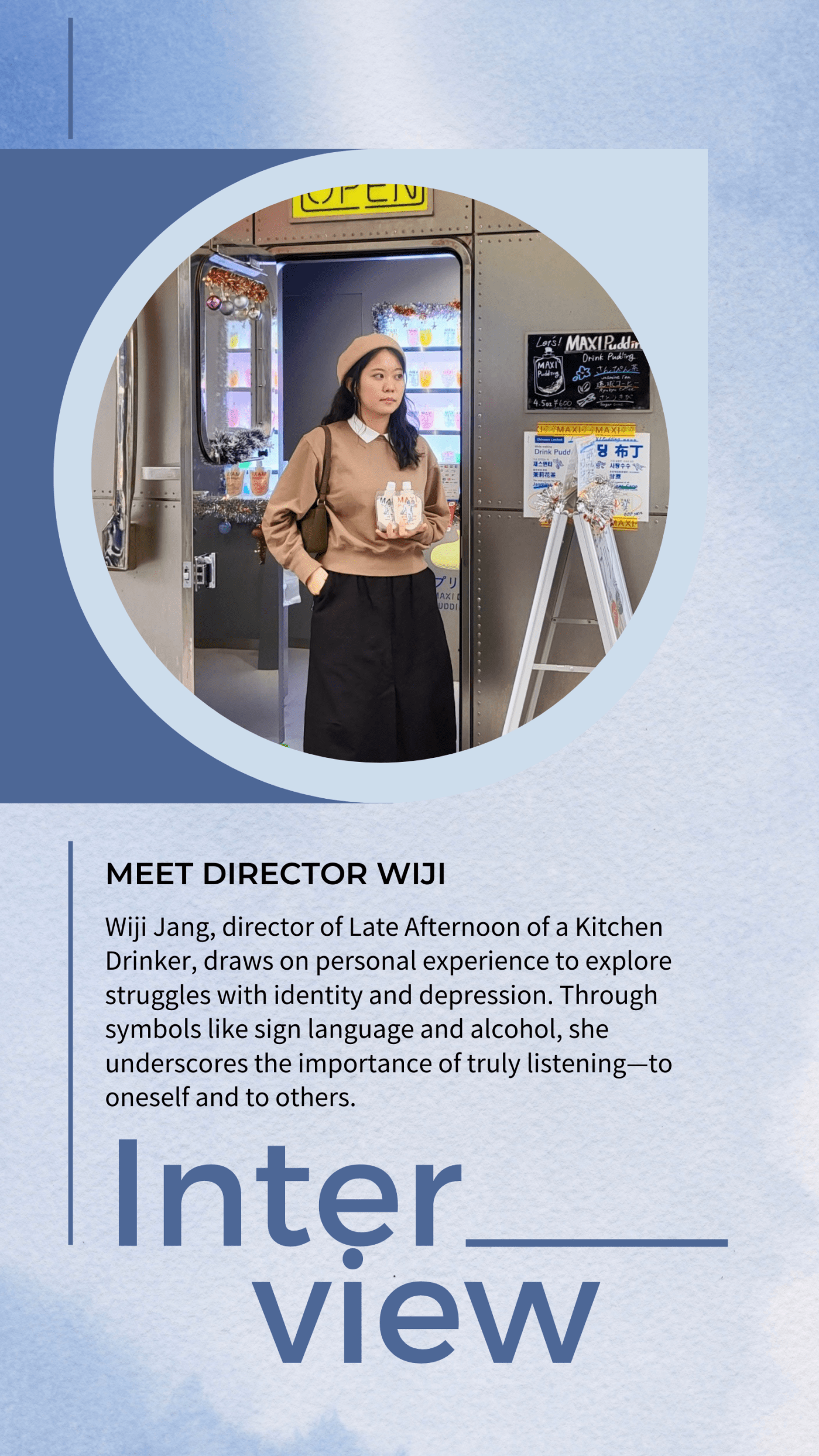
In Late Afternoon of a Kitchen Drinker, director Wiji Jang presents a delicate yet profound journey into the unspoken struggles of identity, motherhood, and quiet despair. Drawing on her own experiences, Jang crafts a world where sign language, water, and alcohol become subtle metaphors for self-reflection, loss, and healing. In an exclusive interview, she reveals the personal inspirations behind her film, her intentional choices in tone and symbolism, and the message she hopes resonates with anyone who has ever felt adrift in the everyday rhythms of life.
Why did you choose to make the protagonist a housewife in Late Afternoon of a Kitchen Drinker?
This film is somewhat autobiographical in many ways. I wanted to portray a day in the life of a protagonist whose sadness goes beyond melancholy to a level where depression becomes part of her routine.
However, this isn’t a film about exploring the root cause of her depression, so I wanted her situation to be something anyone could easily understand. Given that it’s a short film, I felt it was necessary for audiences to quickly relate to her sense of “melancholy” and “lethargy” without a detailed backstory, allowing them to grasp the main theme more directly. That’s why I chose to depict her as a housewife struggling with postpartum depression, someone whose sense of self was disrupted by the career break caused by pregnancy, childbirth, and parenting.

Was there any specific meaning or symbolism behind the use of sign language in the film?
The protagonist keeps her inner feelings bottled up, choosing not to share them with anyone, whether it’s her husband or a close friend. I found it interesting that the person she eventually opens up to is a child with whom verbal communication is challenging.
Moreover, I hoped that the curious and sometimes bothersome habit of children asking “why?” repeatedly would prompt the protagonist to look deeper within herself. I felt that adding an ironic twist — having “Jung-a,” the listener, be a child with hearing difficulties — would amplify this theme. It reinforces the idea that genuine communication isn’t just about hearing, but truly listening attentively, which is why I decided to introduce a child who uses sign language.
Is there a special meaning attached to the element of alcohol in the film?
I gave specific meaning to both alcohol and water in this film. The protagonist’s mother is someone who left both good and bad memories, leaving her mark on every aspect of her daughter’s life, like rings of age on a tree. Many habits she grew up with, like her mother’s drinking, were inherited, both learned and genetic. Depression, too, is a trace passed down from her mother.
I imagined that she would resent herself for adopting her mother’s drinking habits, which she once despised. The animated scenes, such as memories of her mother passed out drunk, her drowning in the bathtub, or the arrival of an ambulance, express her traumatic relationship with her mother’s drinking. The sensation of sinking deeply, as if being submerged underwater, mirrors her descent into depression. Water also represents cleansing, washing away what is dirty. In this way, alcohol and water symbolize different things, allowing viewers to interpret them freely as they watch.
The film’s plot is unique in that it depicts daily life without any major events. What was your intention in emphasizing this ordinariness?
I wanted to show that sadness and depression don’t resolve in a single day but continue in daily life. Even if it seems like there’s some relief one day, it often returns the next without warning. That’s why I chose a tone and color grading that would highlight this everyday feeling.
When the credits roll, we see her erasing all traces of her drinking before her husband returns, resuming her routine as if nothing happened. This ending emphasizes that nothing has truly been resolved and that her bleak daily life will continue.

Is there any memorable episode from the filming process?
One moment that stands out was when a child actor got scared and said she couldn’t continue acting in a particular scene. I panicked for a moment, but the script supervisor and I tried to comfort him by giving him a little “ride” on our backs to lighten the mood. Seeing the sun quickly setting, we were nervous, but we worked hard to keep him calm and, in the end, we managed to get the shot!
What message do you want to convey to the audience through this film?
Ultimately, I want to convey that the person who can understand and empathize with you the most is “yourself.” No matter the wounds or emotional changes you experience, if you don’t abandon your interest in yourself, you’ll eventually rise to the surface, where the warmth of sunlight awaits you.

What kind of films do you want to make in the future?
I’m particularly interested in the inner world of people and what changes occur when different individuals meet and interact. I want to make films that delve into various emotions that people sometimes avoid or ignore. My hope is that these films will give audiences an opportunity to confront, accept, and even love themselves a bit more.
 Terafty
Leave a comment