

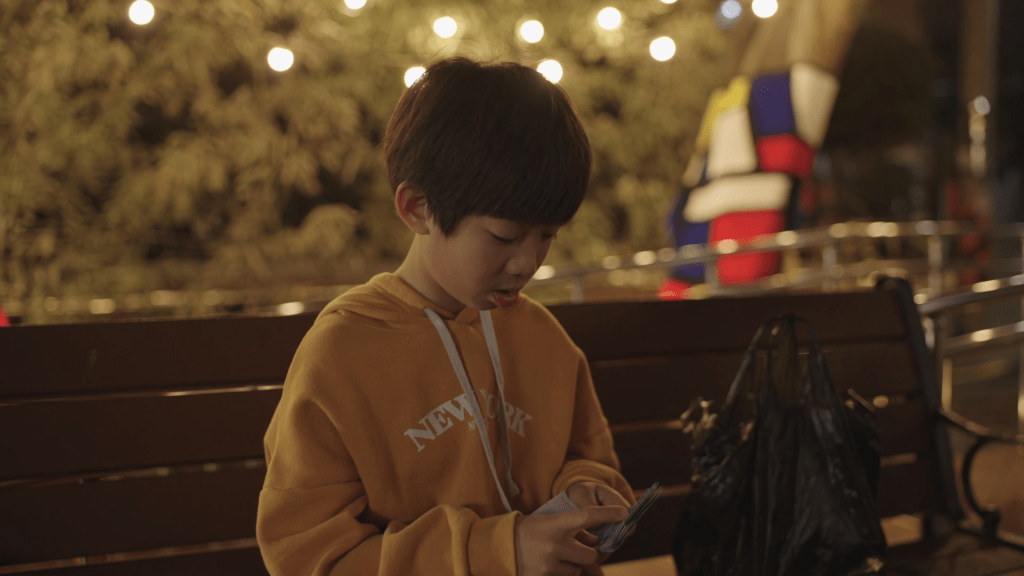
In Taste of Grapes, the director weaves a tender yet raw portrait of childhood, where curiosity, resentment, and the unspoken complexities of family love are brought to life through the eyes of young Ingyu. Inspired by his own experiences growing up with a father who drank, the filmmaker explores the bittersweet moments that define our relationships, highlighting the quiet struggles that come with longing for connection and understanding. With a keen eye for the subtleties of human emotion, he crafts a story that captures the delicate balance between innocence and the harsh realities that shape us, inviting viewers to reflect on the love we often take for granted.
What inspired you to create Taste of Grapes?
I’m currently a second-year film student, but even before joining the film program, I wanted to tell the story of a young child who makes and drinks alcohol. Growing up, I was full of curiosity about alcohol, mainly because of my father, who often drank. If I had been a bit more adventurous as a child, I might have actually tried making alcohol myself.
Of course, I never had the chance to openly express my feelings of disappointment to my father, as shown in the film. I often wondered if my relationship with my father, which only grew more awkward as I got older, could have improved if I’d had more courage. The ultimate goal is to show my father this film, but I haven’t worked up the nerve yet. Through this opportunity, I hope to finally share it with him.

Why did you choose alcohol as a key element in the film?
Alcohol is a crucial element in Taste of Grapes. It serves as a barrier between Ingyu and his father but also sparks Ingyu’s curiosity and helps bring about honest conversations between them. Growing up, I often heard adults say, “People’s true feelings come out when they’re drunk.” I thought it would be powerful to incorporate that idea into the film. Without alcohol, Ingyu wouldn’t have had the courage to confront his father.
What is the significance of Ingyu’s sister in the film?
The character of Ingyu’s sister is inspired by my own real-life older sister. Ingyu’s sister seems to have the freedom to drink and appears to receive all of their father’s affection. She has a boyfriend, drinks withwith their father without hesitation, and even sneaks money from Ingyu’s wallet sometimes. Though she is an ordinary character, to Ingyu, she is someone to envy, a roadblock, and a source of jealousy. I imagine that, like me, she must have questioned her relationship with their father when she was younger, but as she grew older, she likely became desensitized to it. I see a lot of myself in her character.
How do the struggles Ingyu faces at school connect to the film’s theme?
Ingyu’s difficulties at school are closely tied to his struggles at home, particularly his relationship with his father. The assignment to take a photo with his father might seem simple, but for Ingyu, who questions their bond, it’s a daunting task. He feels too awkward to ask his father to take a picture unless his father is drunk, and even then, the sight of his intoxicated father is too embarrassing to display on the school bulletin board.
What did you pay special attention to while working with child actors?
First, my team and I agreed never to raise our voices or use harsh language around the child actors. While that should go without saying, we made it a special point of emphasis. Given our film’s low budget, we often had to shoot overnight, but we made sure to wrap up filming with the child actors before midnight. For scenes set at night, we actually shot most of them during the day using special setups.
I also tried to give clear and simple directions tailored to the kids’ perspectives. That said, Yang Munsu, who played Ingyu, understood my intentions perfectly, even before I simplified my instructions, and delivered an outstanding performance!

What message do you hope to convey to the audience with this film?
Taste of Grapes captures the childhood experiences of many, including myself. My parents both worked full-time, and my older sister, who was much older than me, couldn’t spend much time with me. As I spent more time alone, feelings of resentment toward my family grew, and a sense of lacking love developed. I was jealous of the love my sister seemed to receive from our parents.
As I grew older and started drinking with my father, I heard the phrase, “Alcohol brings out a person’s true feelings.” It made me wonder if the feelings of resentment and jealousy I had as a child were just childish grievances, or if I had simply failed to recognize the love my family gave me.
In the film, young Ingyu hears that alcohol brings out the truth, so he decides to make and drink it himself. I hope viewers of Taste of Grapes are inspired to reflect on their own relationships and the love within their families.
What kinds of films would you like to make in the future?
I believe that directors create films based on their memories and experiences, so I imagine I’ll continue making films about family. I’m not entirely sure why, but family holds a very special place for me, and I believe it’s the same for others. I still don’t fully understand what family truly means. There are so many different forms of family, and I want to explore and tell stories about them through film.
 Terafty
Leave a comment