

Get ready to step behind the camera and into the world of film-making with Yongi Kim, a filmmaker who knows how to tell a story that sticks with you. We got a chance to sit down and chat with him about his latest film, “Regrettable,” and trust us, you won’t want to miss it.
During our talk, we dig into everything from what sparked the idea for the film, the hurdles Yongi Kim and his team faced during production, and those “ah-ha” moments that every creator lives for. Every scene, every character, every line of dialogue in “Regrettable” was crafted with care, creating a film that’s more than just a flickering image on a screen – it’s a piece of living, breathing art.
So come with us, and let’s pull back the curtain together on this remarkable film. Whether you’re a movie buff or just someone who loves a good story, we promise you’ll walk away with a new perspective on what it means to create.
1. Could you please introduce yourself?
Hello, I’m Yongi Kim. I run a film production company called 222film and I’m primarily involved in shooting and directing. Together with my film school coursemates, we have been consistently producing movies, and this is our eighth project. Each time we create a film, we realize there’s always room for improvement. Therefore, we continuously strive to incorporate the lessons learned from our previous works to improve and create better movies.

2. What motivated you to plan “Regrettable”, and why did you decide on the subject of lonely death? Is there a special reason?
The topic of lonely death originated from an idea proposed by Jaehak Han, who portrayed the protagonist in the film. I had also been intrigued by this issue for quite a while, so when I first received the script, I immediately visualized it and determined to direct the film. I wanted to portray the increasing disconnect among families in our society using the theme of lonely death. Additionally, having experienced the era of COVID-19, I wanted to underscore once more the significance of communication.
3. The opening sequence of “Regrettable” is quite distinctive. Could you share some insight into the concept and reason behind the opening?
Considering the weighty theme of lonely death, we designed the opening sequence to be dynamic and engaging rather than monotonous. We conveyed this by reversing the chronological order within the film and by implementing visual elements to evoke curiosity in viewers.
4. Why did you choose to depict family communication through analog methods like sticky notes and letters?
From the son character’s perspective, the use of analog communication methods would have been inevitable. Though it’s not explicitly shown in the film, we envision that initially they tried verbal communication, then text messages, but when there was no improvement, he resorted to posting conspicuous warning signs on the door to his room.
The mailbox also carries symbolic meaning in the film, representing the son’s decision when they found online communication to be ineffective. It also depicts the child’s predicament of not wanting to be disturbed by constant phone notifications, yet disliking being ignored as well.

5. What do you think was the main reason and emotion behind the son’s decision to sever ties with his family?
I believe the son’s decision to sever ties with his family was not so much a deliberate choice as it was an unfortunate outcome of various circumstances. This could be due to stress from excessive interference, misunderstandings arising from generational gaps, or high expectations they have of each other because they are family. A combination of these factors likely led to the situation in the film.
6. The peephole appears in both the opening and ending of the film. What does this element signify? Is there a particular message you’re trying to convey through these scenes?
The peephole suggests the possibility of communication, even amidst severed connections. You can think of it as a window.
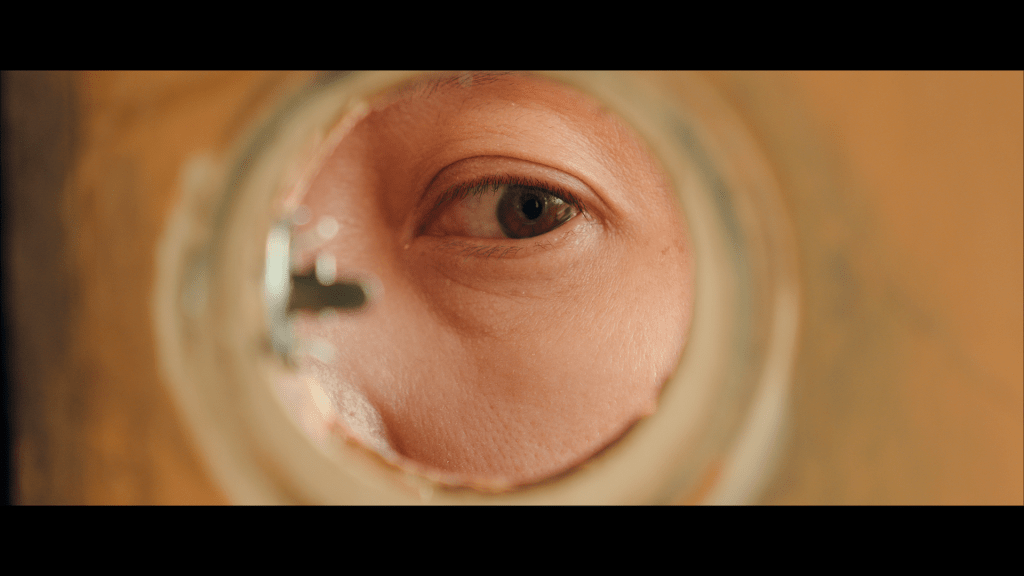
7. Are there any particularly challenging or memorable aspects when you produced “Regrettable” compared to other works?
There were many new attempts in this film. Until this film, I had been exclusively writing and directing my own scripts. However, “Regrettable” represented a departure from my usual method as I directed it from a script written by someone else. The process of turning the script into a storyboard through numerous meetings was a memorable experience.
Furthermore, for the first time, I got to work with senior actors, which was an enjoyable new experience. Lastly, this was the first project where external funding was involved. While this meant there were more external factors to take care of, it also felt like a significant step forward in my growth.
8. You used crowdfunding for the production of “Regrettable”. Could you share some thoughts or feelings about it, and perhaps some advice for other directors considering this approach?
I’m truly grateful for the interest shown by more people than I expected. Although we didn’t reach our funding goal, I found it rewarding to do my best in producing the film within the given constraints. After sending out the rewards, I received supportive and thankful emails from international supporters, which motivated me even more.
If I get another chance, I plan to utilize crowdfunding for my future works, and I encourage other filmmakers to take up the challenge. It will certainly be a good experience.

9. It’s already midway through the year. Do you have any goals for the remaining time this year?
I’m planning two more projects. One is a refreshing horror film for the summer season, and the other is a film set against a snow-covered mountain, a concept that has been repeatedly postponed due to insufficient snowfall during the winter season.
Another goal is to submit “Regrettable” to film festivals, and I hope to participate in these festivals with positive outcomes. (It should be noted for readers that he has already achieved considerable success in this respect, having secured nominations at several international film festivals)
 Terafty
Leave a comment