

Busan, the second largest city in South Korea, is a bustling metropolis that is renowned for its beautiful beaches, rich culture, and delicious seafood. However, for movie buffs and fans of Korean cinema, Busan is also a city that has been featured prominently in numerous films, both as a setting and as a source of inspiration. From nail-biting thrillers to heartwarming dramas, Busan has played host to a variety of cinematic masterpieces that have captured the essence of the city and its people.
In this blog post, we will take you on a journey through the lens of Korean cinema and explore some of the most iconic films that have been shot in Busan. Whether you’re planning a trip to this vibrant city or simply looking for some great movie recommendations, we’ve got you covered.
1. The Attorney (2013)

The film “The Attorney” offers a poignant and compelling portrayal of injustice, corruption, and political awakening through the eyes of Song Woo-seok, a self-made attorney driven by ambition and the desire to secure prosperity for his family. Although the movie starts slow, with a focus on Song’s journey to establish his practice, his character soon becomes enmeshed in the turbulent political atmosphere of 1980s South Korea, where he must confront the corrupt officials and laws that are responsible for the arrest and torture of a friend’s son as a suspected communist.
What follows is a riveting and emotionally charged courtroom drama that underscores the tremendous courage and determination of Song as he takes on an entire justice system. The cinematography is skillfully executed, with expertly paced editing that keeps the viewer on the edge of their seat. Actor Song Kang-ho delivers a standout performance, effortlessly bringing to life the complex and multifaceted character of Song Woo-seok with remarkable depth and nuance. Through his portrayal, viewers can easily identify with Song’s struggle against a system that is often unjust and unyielding.
In essence, “The Attorney” is a masterful exploration of Korean culture and history, offering a vivid portrayal of the nation’s political and social struggles in the last century. While the film is set against the backdrop of South Korea in the 1980s, its themes and messages are universal, speaking to the human condition and the quest for justice and truth. “The Attorney” is a powerful and inspiring cinematic achievement that deserves to be seen and celebrated.
2. Ode to My Father (2014)

“Ode to My Father” is a Korean movie directed by Yoon Je-kyoon, which tells the emotional and epic story of Yeon Deok-soo. The film covers six decades of his life, starting from the Korean War in 1951, when he lost his father and younger sister during the Hungnam evacuation. Settling down in Busan, Deok-soo became the man of the house and worked hard to support his family. Extreme financial needs took him abroad as a miner in Germany in the 1960s and as a non-military personnel in Vietnam in the 1970s. During the 1980s, he tried his luck in locating his lost father and sister through TV shows that helped reunite family members estranged during the Korean War. The story is presented through flashbacks as an elderly Deok-soo (Hwang Jeong-min) tries to hold on to his family and memories while managing his store.
The film’s production design is outstanding, and it portrays the different periods in different countries where the hero spent his life. The scenes depicting the Hungnam evacuation of 1951 were especially spectacular in scope and rich in detail. The scenes in the dangerous mine shafts of Germany and the war-torn villages of Vietnam are also excellently crafted, conveying the difficulty and tension of such dire situations. The drama of the families reconnecting on TV feels real and compelling. The film has a “Forrest Gump” feel as we follow the life of Deok-soo through his extraordinary experiences over the decades.
The cast members played their roles convincingly, especially Hwang Jeong-min, who portrayed Deok-soo from youth up to an elderly age with conviction and heart, making the audience completely absorbed into his life journey. Oh Dal-su provided the film’s comic relief as Deok-soo’s close friend Dal-gu, and Kim Yun-jin played Deok-soo’s supportive wife Young-ja, who also had the opportunity to show that she can speak her mind. Jang Young-nam played Deok-soo’s long-suffering mother, and Ra Mi-ran played his enterprising aunt Kkot-bun. The director, Yoon Je-kyoon, played his rich winning hand of a story with dramatic flair, making the audience connect with Deok-soo’s travails and become emotionally involved in the family issues depicted in the film.
The film can resonate with people from various backgrounds, even if they are not Koreans, and are not familiar with the historical events. The film’s portrayal of the family story, adversities, and emotional connections can transcend cultural boundaries. In summary, “Ode to My Father” is a beautifully told story with meticulous attention to detail, and it is presented on the screen with excellent production values, acting, and direction, making it a must-watch movie for people who appreciate emotional and epic stories.
3. Nameless Gangster: Rules of the Time (2012)
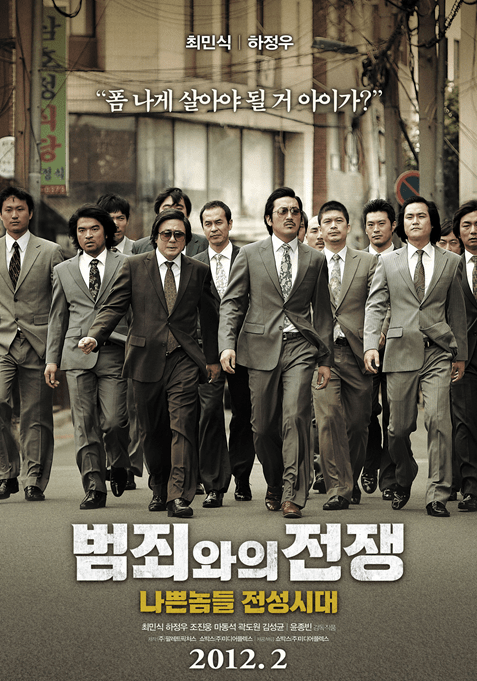
“Nameless Gangster: Rules of the Time” is a gangster movie that tells the story of a man named Choi Ik-hyun who stumbles upon a robbery, chases off the robbers, and discovers they were after several pounds of heroin. Choi is a civil servant at the docks of Busan, who eventually becomes a kingpin in the drug trade. Min-sik Choi’s portrayal of Choi Ik-hyun is filled with passion, and his performance is comparable to his previous works in “Oldboy” and “I Saw The Devil”. His character is a blood-sucking leech that manipulates and uses people for his own benefit. This character’s less-than-endearing personality may be tempered by the revelation of his difficult family background, leading the audience to feel a complex mix of emotions towards him.
Ha Jung-woo, who played Choi Hyung-bae, did an excellent job in portraying his character’s progress and development throughout the movie. He showed that he can be as catchy as any other superstar actor in the world with his “Gangster” mood, which was simply incredible. The progression and development of Hyung-bae’s character are impressive, making him a likable character despite being a gangster. The movie’s atmosphere, progress, conflicts in interest, and personal feelings create a roller-coaster of emotions that keep viewers interested.
With stellar performances by Choi Min-sik and Ha Jung-woo, “Nameless Gangster: Rules of the Time” provides a gritty, realistic look into the criminal underworld of Busan during the 1980s. The film is a must-watch for fans of gangster dramas and Korean cinema alike.
4. Train to Busan (2016)

“Train to Busan” is a zombie film directed by Yeon Sang-ho, who has breathed new life into the zombie genre with this film. Yeon makes the most of his confined setting, a packed train, to expertly create an intense atmosphere as the passengers fight for survival against the zombies. The zombies are fast-moving and relentless in their quest for human flesh, and the attack scenes are well-executed, using a combination of practical and computer-generated effects. The audience feels the tension and excitement as the zombies swarm to break through barriers and pile up in droves and hordes.
The central character is Seok-woo, a man stressed out with problems about his investments business and his divorce, who is taking his neglected daughter, Su-an, to see her estranged mother in Busan. The father-daughter dynamic is at the forefront of the film, as the two try to survive the zombie attack together. Along with Seok-woo and Su-an, the audience meets a cast of supporting characters on the train whose fates we follow for the rest of the film. We get just enough introduction about who they are to care about what happens to them. Gong Yoo plays Seok-woo convincingly, and Kim Su-an is the dramatic core of the film as the daughter reaching out to her jaded father.
The film is not just about the zombies; it covers the drama of human relationships and interactions that rises above the horrific and thrilling carnage. Yeon Sang-ho’s first two feature-length films, “The King of Pigs” and “The Fake,” were both animated films inspecting the bleak side of human nature. With his first live-action directorial effort, Yeon has created a complete film that uses the zombie genre to create an intense and exciting atmosphere while also investigating the complexity of human relationships. “Train to Busan” is one of the better zombie films to come out in recent years.
5. Friend (2001)

“Friend” is a compelling Korean film that examines the complex dynamics between two childhood friends who take divergent paths in life and end up as enemies as they become gangsters in different factions. The movie’s success can be attributed to its depiction of male friendship, which is an essential part of Korean culture, particularly in the city of Busan, where loyalty and sacrifice for friendship is considered a crucial part of honor. The film’s direction is excellent, and the acting, particularly that of the two leads, is exceptional, with Yoo Oh-Sung playing the mafia gangster, and Jang Dong Gun playing the charismatic and striking thug.
The story is genuine and touching, and it offers a powerful portrayal of the passage of time, nostalgic sentimentality, and the relations of friends. Director Kwak’s personal experiences inspired the movie, giving it an intimate touch that resonates with viewers. The film’s calm, reflective nature makes it easy to watch, and the production quality, including the camera work, is exceptional. This film is a work of art that is sure to captivate anyone with a passion for gangster films or heartwarming stories about friendship.
The film’s characters are human, and their paths take them on a journey to adulthood with a whimsical struggle of will by the protagonist, Joon-suk, the main tough guy. He accepts the horrors of being a gangster with a stolidity that evokes the late Lee Strasberg’s famous line from The Godfather, “These are the lives we’ve chosen,” but he shows loyalty goes both ways. The film portrays real human characters growing up in a society that is rigidly disciplined, yet dynamic, and it hints at issues that torment great men. By seamlessly blending stark realism with heartfelt emotion, this film presents a searing portrait of the complexities of male friendship, immersing viewers in a world of richly drawn characters and profound themes that will stay with them long after the credits roll.
Overall, “Friend” is an exceptional movie that should not be missed by anyone interested in gangster movies or stories about friendship. It is a touching and emotional story that resonates with viewers, and the exceptional acting and direction add to its charm. This cinematic gem takes an unflinching look at the intricacies of male friendship, weaving together a powerful and moving narrative that will touch the hearts of those who watch it.
As we wrap up our exploration of Busan’s cinematic landscape, it’s clear that this city has left an indelible mark on Korean cinema. Through its unique blend of urban sophistication and natural beauty, Busan has served as the perfect canvas for filmmakers to tell their stories. Whether you’re interested in political dramas, action-packed thrillers, or emotional family sagas, there’s a Busan film out there for you. So, the next time you find yourself looking for some cinematic inspiration, consider taking a trip to Busan through the lens of Korean cinema.
 Terafty
Leave a comment